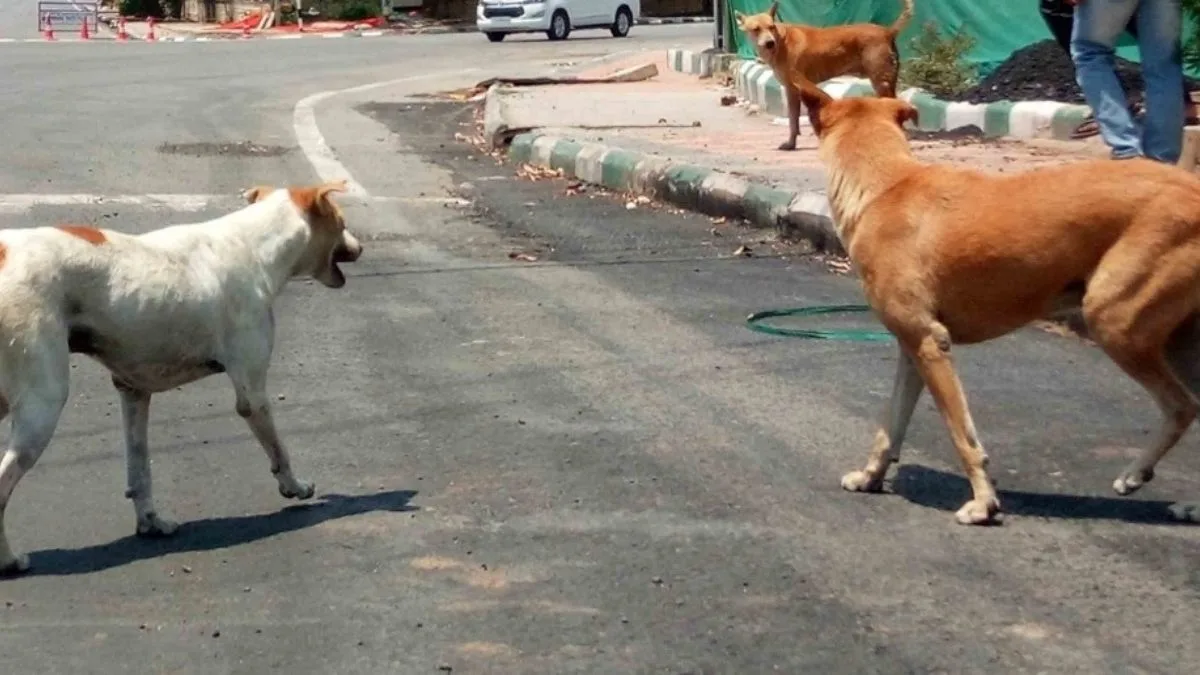
Linking the issue of the stray dog menace to the right to life under Article 21 of the Constitution, the Supreme Court on Tuesday held that citizens have the right to live with dignity and move freely in public spaces without fear of dog bites and violent attacks. The Court also directed authorities to euthanise rabid, incurably ill, and demonstrably dangerous or aggressive stray dogs in accordance with the law.
Observing that incidents of dog bites and stray dog attacks were occurring across the country with “alarming frequency and severity”, a Bench comprising Justice Vikram Nath, Justice Sandeep Mehta, and Justice N.V. Anjaria said the consequences were not merely statistical but carried grave human, societal, and public health implications.
Advertisement
“The right to live with dignity under Article 21 of the Constitution of India necessarily encompasses the right of every citizen to move freely and access public spaces without living under a constant apprehension of physical harm, attack, or exposure to life-threatening events such as dog bites in public areas,” the Bench said in its judgment.
The Court held that in areas where the stray dog population had reached alarming proportions and attacks had become frequent, authorities may, after assessment by qualified veterinary experts and strictly in accordance with the Prevention of Cruelty to Animals Act, the Animal Birth Control (ABC) Rules, and other statutory protocols, take legally permissible measures, including euthanasia of rabid, incurably ill, or dangerous dogs, to curb threats to human life and safety.
At the same time, the Court protected officials implementing these directions in good faith, holding that government authorities carrying out such measures would be entitled to legal protection. FIRs against them could be registered only where a prima facie case of mala fide action or gross abuse of authority existed.
The judgment strongly criticised the inadequate implementation of the Animal Birth Control framework, observing that sterilisation and vaccination programmes had remained sporadic, underfunded, and uneven across the country.
Justice Sandeep Mehta, speaking for the Bench, observed that had States and Union Territories acted with due diligence from the inception of the ABC regime by augmenting sterilisation capacity, vaccination drives, and institutional infrastructure, the situation would not have reached such alarming proportions.
“Had the States and Union Territories acted with due diligence and foresight in implementing the mandate of the Animal Birth Control framework from its inception, including the timely and phased augmentation of sterilisation capacity, sustained vaccination drives, and the development of adequate institutional infrastructure, the present situation would not have assumed such alarming proportions,” the judgment said.
Referring to recurring incidents involving children, elderly persons, and even international travellers being attacked by stray dogs, the Court said neither the State nor constitutional courts could remain passive spectators when preventable threats to human life continued to proliferate.
“This Court cannot remain oblivious to the harsh and deeply disturbing ground realities emerging from various parts of the country, where young children have been mauled, elderly persons attacked, ordinary citizens left vulnerable in public spaces, and even international travellers have fallen victim to such incidents,” the judgment noted.
The Court issued a series of directions to States and authorities, including strengthening implementation of the ABC Rules, establishing at least one fully functional ABC centre in every district, and expanding such centres depending on population density. Authorities were also directed to take reasoned and time-bound decisions regarding extending safeguards to other public spaces to ensure public safety.
The Court further ordered States to ensure adequate availability of anti-rabies medicines and directed the National Highways Authority of India (NHAI) to address the issue of stray animals on national highways through a dedicated monitoring and coordination mechanism.
In a significant direction, the Court asked all High Courts to initiate suo motu proceedings to monitor compliance with the present judgment as well as earlier directions issued in the matter. Chief Secretaries of all States and Union Territories have been directed to file compliance reports before the concerned High Courts by August 7.
The issue of stray dog management had gained national prominence after an earlier Supreme Court order directing municipal authorities in Delhi to round up and shelter stray dogs triggered protests from animal rights groups.
That order was later modified by the present three-judge Bench, which shifted the focus towards sterilisation, vaccination, and regulated release under the ABC Rules.
On November 7, 2025, the Court had also directed the removal of stray animals from highways, schools, hospitals, and other institutional areas, and ordered fencing of educational and health institutions to prevent dog attacks. Multiple petitions challenging those directions were later heard together, leading to Tuesday’s judgment.